A Sensor That Feels in Nanograms
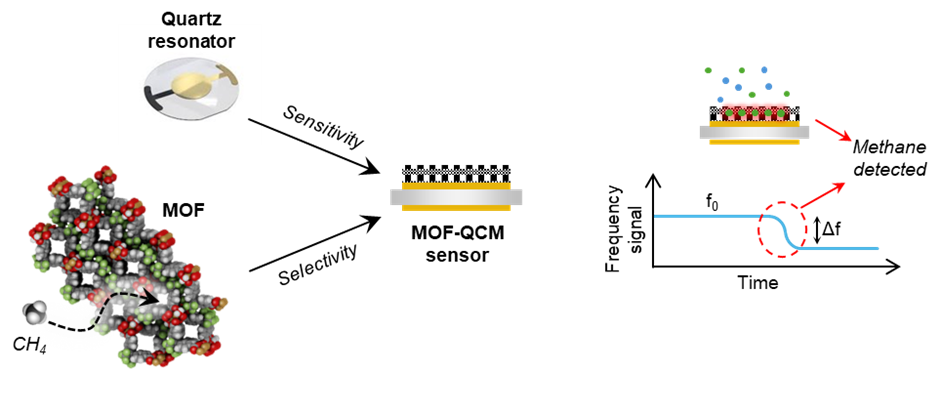
The team’s early breakthrough came through combining MOFs with quartz crystal microbalance (QCM) technology - a very sensitive microbalance that can measure miniscule mass changes (on the order of nanograms). They created MOF-QCM sensors that are both selective towards methane and sensitive towards tiniest of mass changes. When methane or other hydrocarbons are captured by the MOF, the additional mass shifts the quartz’s vibration frequency, which is being continuously measured. This method allows for detection of dissolved methane to as low as 100 parts per billion and very rapidly (under 60 seconds).
Building on this success, Jaskaran is now working on the next step: integrating MOFs into fiber optics. This approach allows for the creation of distributed sensor networks capable of monitoring vast areas of the seafloor. By having hundreds of microscopic sensor units along a long fiber, it becomes possible not only to detect leaks but also to pinpoint their exact location.
“It’s like having a grid of tiny sensors across kilometres of ocean floor,” he says. “The technology could provide operators both early detection and geolocation of the leaks.”
Five Institutions, One Sensor
Collaboration has been central to Jaskaran’s work from the beginning. He works closely with colleagues from diverse backgrounds in materials science, chemistry, and electronics both within DTU Offshore and externally with partners at DTU Engineering Technology, DTU Chemistry, DTU NanoLab, the University of Pau, and industrial stakeholders, including TotalEnergies.
Former DTU Offshore researcher Jonas Sundberg, Jaskaran’s PhD supervisor and co-founder of their startup, remains an active collaborator, guiding the commercialisation of the sensor technology. Together, they are transforming lab-based innovations into market-ready solutions.
“These kinds of interdisciplinary collaborations are what make DTU Offshore unique,” Jaskaran reflects. “You combine the expertise of several experts and create something truly impactful.”
From Methane to PFAS: One Principle, Many Applications
Jaskaran’s work directly supports the offshore industry’s move toward safer and more sustainable operations. His sensors provide faster, more precise data that helps companies monitor well integrity and prevent methane emissions - contributing to both climate goals and marine ecosystem protection.
Beyond methane detection, his research has potential applications in carbon capture and storage (CCS) and in detecting and capture of pollutants such as PFAS, the so-called “forever chemicals.” By adapting the same sensing principle, these technologies could play a role in reducing environmental impact across the offshore and process industries.
“Our sensors don’t just measure, they enable action,” Jaskaran says. “By giving stakeholders reliable data in real time, we help them respond before any significant environmental harm occurs.”