Abandonment of Offshore Oil and Gas Fields
Robust and cost-effective abandonment for short- and long-term environmental protection.
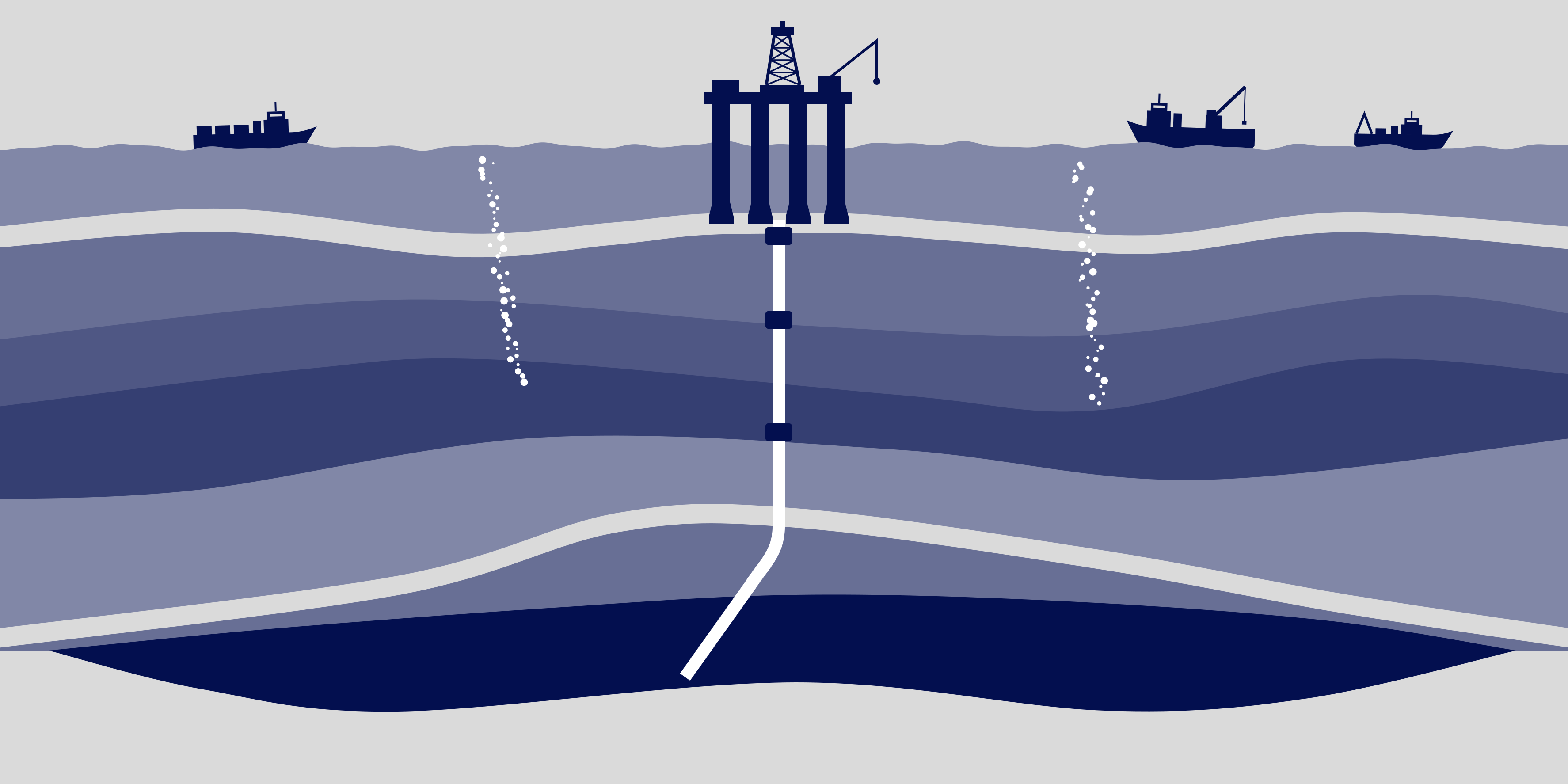
Denmark has committed to ending oil and gas production by 2050. The largest offshore decommissioning challenge lies beneath the seabed: several hundred wells in the Danish North Sea must be permanently abandoned - a technically demanding and costly process with potential environmental consequences. These include short-term operational impacts, the long-term risk of hydrocarbon seepage from abandoned wells, and ecological disruption from removing subsea infrastructure that may protect marine habitats.
At DTU Offshore, research focuses on reducing the environmental risks associated with well abandonment. Working closely with industry, researchers develop seabed monitoring systems, model subsurface methane seepage, and investigate biochemical and geochemical approaches to prevent impacts. The work draws on expertise across environmental engineering, chemistry, geology, and reservoir engineering.
Abandoned oil and gas wells pose a risk of methane seepage into the water column if well barriers fail or degrade over time. DTU Offshore is developing continuous seabed monitoringsystems capable of detecting and quantifying methane leakages - both around individual wells and across larger multi-well areas.
Advanced sensor technology addressing offshore methane monitoring gap
Fiber Optic Sensor for Monitoring CO₂ Near Storage Sites
Detecting elevated methane levels is only the first step: the next step is determining whether the source is natural or anthropogenic. DTU Offshore and partners are developing a surveillance system that uses isotopic differentiation to distinguish between thermogenic and biogenic methane, thereby establishing the origin of any detected seepage.
Distinguishing natural seabed methane from leaks at abandoned wells
Natural hydrocarbon seepage occurs across the North Sea, and many oil and gas wells are located in areas with pre-existing seepage activity. Before a well is abandoned, it is therefore essential to establish a seepage baseline around the platform - without which post-abandonment monitoring has no reliable point of reference. DTU Offshore and partners are developing a methodology for systematic baseline data collection and modelling to support responsible offshore decommissioning.
Long-term environmental protection after well abandonment depends on barrier materials that retain their integrity under subsurface conditions over extended timescales. Cement remains the predominant well barrier material, and DTU Offshore is investigating how different cement types behave at subsurface over time - knowledge that is essential for validating abandonment designs.
Wells abandoned under legacy standards and regulations present a particular challenge, as their barrier integrity cannot always be verified against current requirements. DTU Offshore is developing risk assessment tools to quantify the likelihood and consequence of leakage from such wells - work that is equally applicable to the qualification of new well barrier materials.
When the Danish North Sea wells were drilled, the primary objective was reaching the reservoir, and systematic data collection across the overburden received limited attention. Abandonment, however, requires confidence that all formations with flow potential are effectively isolated - a requirement that demands a more detailed understanding of overburden geology than was typically acquired during drilling. DTU Offshore researchers are investigating flow potential in shallow permeable zones, with particular attention to the Diatomite formations.
Unveiling the Flow Secrets of Diatomite Reservoirs
Petrophysics Partnership with Aker BP: Advancing Subsurface Understanding
The wells also pass through several shale formations with natural swelling properties. DTU Offshore and DTU Sustain has been examining whether these shales can serve as natural well barriers, contributing to long-term barrier integrity at geological timescales. Because cores are rarely available from these formations, researchers have developed a method for characterising swelling behaviour using drill cuttings.
Decommissioning an oil and gas field requires the removal of all installations from the seabed upwards. Yet over decades of operation, these structures often become established habitats for marine species - a consideration that must inform offshore decommissioning decisions.
DTU Offshore and DTU Aqua are investigating the ecological role of subsea structures for cod communities in the Danish North Sea, examining both population density and behavioural patterns around the structures. Preliminary findings suggest that the structures have a measurable positive effect on local fish communities. Field data were collected around the Skjold platform during the summer of 2023.
A separate baseline study conducted by DTU Offshore and GEUS found that bivalve communities in the vicinity of platform structures are thriving compared to locations away from platforms, suggesting that the structures may provide a degree of protection or ecological benefit. See Environmental baselines.
Scientists examine offshore installations’ role for marine life
Exploring Life Beneath the Surface
Contact
Ulla Hoffmann Programme Director Danish Offshore Technology Centre Mobile: 9351 1360 uhoff@dtu.dk