Research
Petrophysics Partnership with Aker BP: Advancing Subsurface Understanding
Collaborating with Aker BP, DTU Offshore researchers are deepening our understanding of how unconventional reservoir rocks behave, helping bridge the gap between laboratory insights and field-scale challenges.
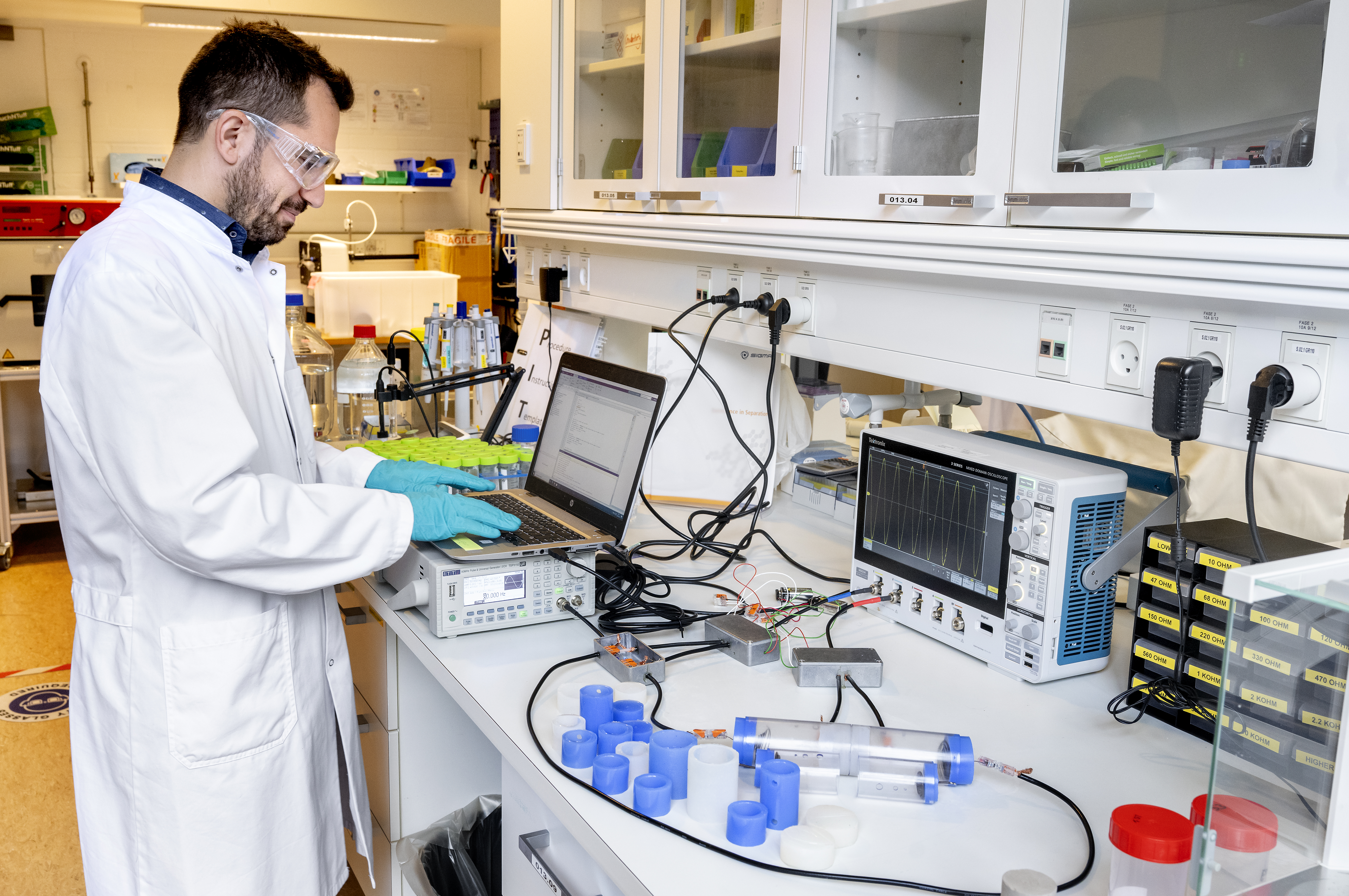

Calibrating Field Data
To bring laboratory findings into the field, the researchers use borehole logging data provided by Aker BP. As Ida Lykke Fabricius explains, “Logging data gives us a continuous record of rock properties along the well. But to interpret those signals correctly, we need laboratory data for calibration and mechanistic modelling. That’s where our collaboration becomes vital - translating small-scale measurements into large-scale understanding”.
Academia Meets Industry
According to Project Lead, Birgitte Dalsgaard Larsen, the partnership between DTU Offshore and Aker BP is a model for mutual engagement and knowledge exchange. Regular meetings and workshops with Aker BP’s petrophysicists, geologists, reservoir engineers, and geomechanics specialists provide access to core samples, logging data, and real-world challenges.
"In return, we deliver experimental results and interpretations that help improve their reservoir understanding,” says Shohreh.
For Ermis, the collaboration is more than just technical - it’s deeply interactive. “It’s not only about funding or data sharing. Aker BP’s teams are genuinely interested in the underlying physics of the rocks. That makes our research both relevant and rewarding.”
The project also fosters a multidisciplinary collaboration, including DTU Sustain (for geochemical analysis), DTU Space (for geophysical signal processing), and the external partner, GEO (for geotechnical and mechanical modelling).
“Petrophysics sits at the crossroads of geology, physics, and engineering,” says Ida. “Projects like this one show how interdisciplinary collaboration can turn scientific insight into practical impact.”
From Reservoir Physics to Sustainable Solutions
Although the project focuses on reservoir characterisation, its outcomes extend beyond oil and gas. The knowledge and methods developed in the collaboration are directly applicable to CO₂ storage, geothermal systems, and subsurface integrity monitoring - all essential to the energy transition.
“Understanding rock behaviour under stress is universal,” explains Ermis. “Whether you’re injecting CO₂ or extracting heat, you need to know how the rock will deform and how fluids move within it. That’s the same physics, just applied to a new challenge.”
Shohreh adds, “By improving our ability to interpret petrophysical data, we also improve our capacity to monitor the safety of CO₂ storage and optimise geothermal energy extraction. The insights we gain from one field directly support the technologies of tomorrow.”
For Ida, the collaboration exemplifies DTU Offshore’s mission. “We’re taking decades of expertise in subsurface characterisation and applying it to sustainable energy solutions,” she says. “That’s how research helps accelerate the energy transition - by transforming knowledge into tools that industry can use.

The Next Chapter: AI, Integration, and New Rock Types
The success of the Aker BP collaboration is already shaping future research directions at DTU Offshore. The next steps include refining data integration workflows, developing machine-learning-assisted petrophysical models, and expanding laboratory testing capabilities for a wider range of rock types.
“Artificial intelligence is a great support tool,” says Ermis. “It can recognise patterns and relationships in large datasets, but interpretation requires domain expertise. AI should enhance, not replace, petrophysical understanding.”
Shohreh also looks to the future with enthusiasm: “Every time we compare new data with existing models, we challenge our assumptions. That’s how progress happens. It’s exciting to see our results being used directly in field development strategies.”
As the collaboration continues, both DTU Offshore and Aker BP are proving that open dialogue between academia and industry is key to solving the complex challenges of the subsurface, paving the way for safer, more efficient, and more sustainable energy systems.
Contact
Ermis Proestakis Postdoc Danish Offshore Technology Centre ermpr@dtu.dk
Birgitte Dalsgaard Larsen Geoscience Advisor Danish Offshore Technology Centre Mobile: +4593511836 blarsen@dtu.dk
Shohreh Iraji Postdoc Danish Offshore Technology Centre Mobile: +4591621785 shoir@dtu.dk
Michael Welch Senior Researcher Danish Offshore Technology Centre Mobile: 9351 1572 mwelch@dtu.dk
Ida Lykke Fabricius Professor Emerita Department of Environmental and Resource Engineering Mobile: +45 23397265 ilfa@dtu.dk
Finn Engstrøm Guest Researcher Mobile: +45 21564831 finneng@dtu.dk