Facts
Nicolas Bovet
Nationality: French
Educational Background:
- PhD, Physical Chemistry, University of Nottingham, 2002 - 2006
- Master's degree, Materials Chemistry, Université Bourgogne Europe, 1996 - 2001
Portrait
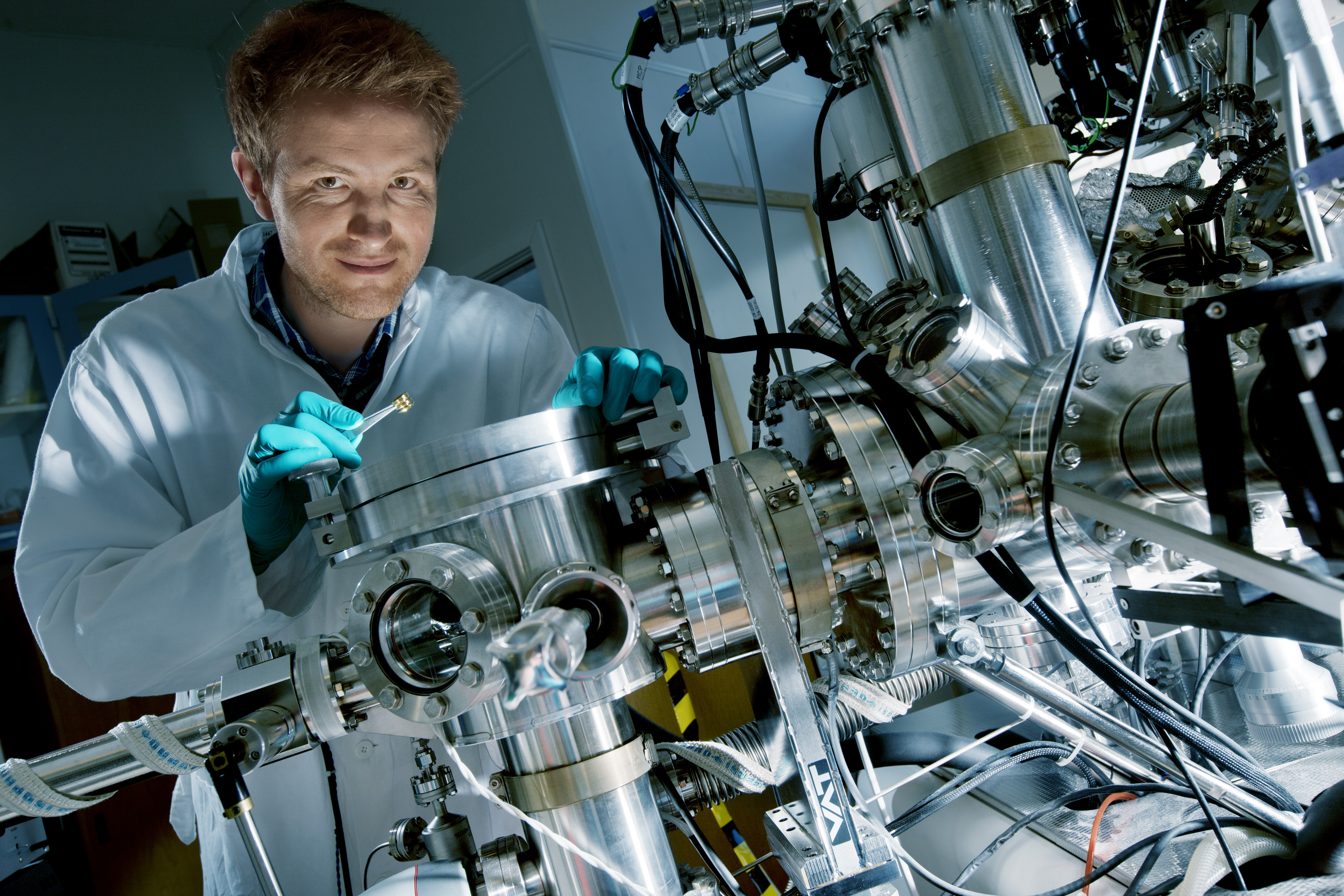
With a passion for material interactions and a background in chemistry, Nicolas Bovet bridges the gap between molecular insight and large-scale offshore challenges - advancing research in carbon and hydrogen storage one nanometer at a time.

Collaboration as a Cornerstone
A strong believer in collaboration, Nicolas has worked closely with both internal colleagues at DTU and external partners across Europe. He is actively involved in three CCS-related projects in collaboration with GEUS and maintains long-standing ties with DTU Physics, where part of his time and instrumentation resources are based. These partnerships enable him to contribute with a unique perspective to interdisciplinary teams; especially in bridging experimental and modelling approaches.
“The more perspectives you have, the better your outcomes”, Nicolas says. “I may not run flow simulations, but I can help the people who do by reminding them that the rock’s surface chemistry could affect everything”.
Internally, Nicolas has collaborated on surface analysis for chalk reactivity and other joint projects, often stepping in when others see the potential to deepen their work with material characterisation. “When people know what I can offer, we can create something together that’s more than the sum of its parts”, he states.
Facts
Nationality: French
Educational Background:
From Prediction to Reality
With the CCS landscape still in its early stages, much of today’s work is speculative - trying to anticipate what might happen once large-scale CO₂ injection begins. But as projects move from theory to practice over the coming years, Nicolas sees a growing role for material scientists like himself.
“Once we start injecting real volumes of CO₂ or hydrogen, we’ll finally get the data and samples we’ve been waiting for”, he says. “That’s when we can test our assumptions, improve our models, and support better decision-making”.
He’s also eager to expand into new areas like hydrogen storage, applying the same methods to new gases and challenges. Past work in well abandonment and polymer-based sealing systems further illustrates his drive to explore novel applications with tangible impact.
Nicolas Bovet Senior Researcher nbovet@dtu.dk