MOF-Based Sensors for Detecting CO2 and CH4 Leaks in Marine Environments
Using advanced metal-organic frameworks (MOFs), researchers are creating highly selective sensors for detecting methane, CO2 and other pollutants in marine environments.

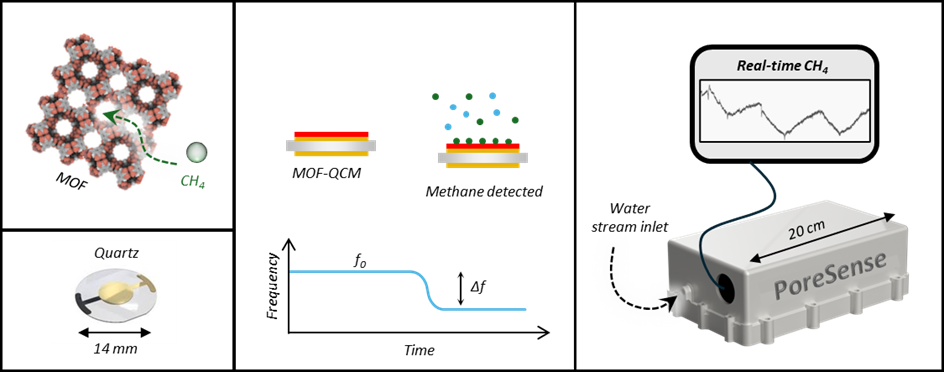
Detection and removal of potential pollutants is an essential part of produced water management. At DTU Offshore, we have been developing sensor (and some capture) technologies based on a special class of adsorbent materials – Metal-organic frameworks (MOFs) for the last five years. Our most mature project – “a MOF-based quartz sensor for detection of dissolved methane” demonstrates our ability to transform functional materials into technology (Fig 1). With our “soon to be” patented technology, we have achieved a detection limit of 100 ppb and fast response time (under 60 seconds) as we continue to develop it towards commercialization.
MOFs are network porous materials with a defined crystal structure formed via coordination of organic linker molecules and metal nodes. The well-defined pores, combined with electronic interactions, makes them very selective towards capturing molecular entities (such as CO2, CH4, benzene). We couple this selectivity of MOFs with highly sensitive sensing platforms based on changes in mass and optical properties.
Quartz is a piezoelectric material and forms one such platform in the configuration – quartz crystal microbalance (QCM). Here, a thin disc (~160 μm) of quartz resonates at a fundamental frequency (~10 MHz) when excited by a small AC voltage. This frequency is extremely sensitive to mass change, exhibiting a sensitivity of ~1.25 ng/Hz. For our flagship project, we functionalize quartz resonators with a CH4-selective MOF such that the event of CH4 adsorption into the MOF results in a measurable frequency shift (Fig. 1).
Strain sensing based on fiber Bragg gratings (FBGs) is another sensitive technology wherein, tiny strain changes are measured by monitoring the reflected optical signal from the FBG. Such strains can result from adsorption events into MOFs coated around the FBG, thereby creating another avenue for a selective and sensitive technology for monitoring pollutants from produced water.
We have several projects based on developing pollutant-specific MOFs into sensing platforms – MOF-QCM sensor for methane monitoring, MOF-FBG sensor for CO2 monitoring, MOF-QCM sensor for monitoring BTEX in water and capture technologies – MOFs for PFAS capture. We are always keen on collaborating and developing similar projects for monitoring as well as capture of pollutants based on your specific requirements.
Contact
Jaskaran Singh Malhotra Postdoc Danish Offshore Technology Centre Mobile: +4555209210 jsima@dtu.dk
Simon Ivar Andersen Research Director and Professor, Chemical Impact of Offshore Energy Production Danish Offshore Technology Centre Mobile: 9351 0758 simand@dtu.dk