Advanced sensor technology addressing offshore methane monitoring gap
As Denmark phases out fossil fuel extraction by 2050, large-scale decommissioning and plugging of oil and gas wells will require effective monitoring to mitigate the risk of methane seepage and associated greenhouse gas emissions. A new project advances a novel quartz crystal microbalance (QCM)-based sensor for rapid detection and quantification of dissolved methane in dynamic marine environments, supporting implementation of EU monitoring regulations and offshore climate mitigation efforts.

Currently available dissolved methane sensors suffer from slow response times, which makes them ineffective in dynamic marine environments, where they struggle to monitor slight variations and detect potential leaks. It is therefore a problem implementing the new regulations for monitoring of methane seepage from abandoned sites.
To address this gap, the SEAL - Seabed Environmental Analyzer for CH4 Leakage - project introduces an advanced sensor technology with a fast response time, making it suitable for high-temporal-resolution monitoring. The sensor has been developed as a laboratory prototype as part of a PhD project and DTU has filed a patent application for the sensor.
The project aims to further mature the sensor towards commercialization and application by developing an offshore prototype and pilot testing it at offshore conditions. This project addresses critical gaps in ocean monitoring and represents a significant step towards the commercialization of advanced sensors for environmental protection and the support of global greenhouse gas mitigation.

Currently available dissolved methane sensors utilise technology developed more than three decades ago and are characterised by slow response times due to diffusion-driven processes. This limitation reduces their effectiveness in dynamic marine environments, where they struggle to monitor slight variations and detect potential leaks promptly. As a result, implementation of recently adopted EU regulations for monitoring abandoned oil and gas sites is challenged by the lack of suitable technology.
To address these shortcomings, the SEAL project introduces an advanced sensor technology based on a quartz crystal microbalance (QCM), achieving a response time of under 60 seconds and enabling high-temporal-resolution monitoring in dynamic marine environments. The sensor incorporates a microporous material layer that selectively binds methane, allowing rapid and precise detection. A prototype has been developed and validated under laboratory conditions as proof-of-concept as part of a PhD project, and DTU has filed a patent application for the sensor.
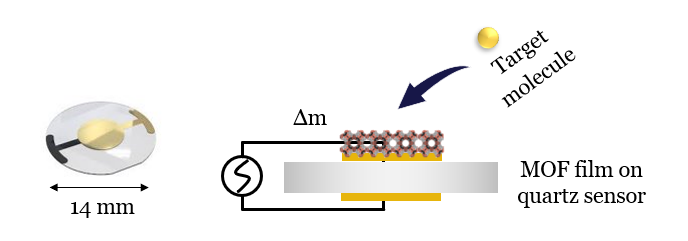
The objective of the SEAL project is to mature the current research results towards a commercially applicable offshore product. This will involve development of a fully functioning prototype suitable for offshore conditions. The system will be validated in simulated laboratory environments and pilot-tested at two real-life locations: one near-shore site and one offshore site with environmental conditions representative of those surrounding oil and gas platform installations.
This initiative addresses a critical gap in ocean monitoring technology and represents an important step towards commercialisation of advanced environmental sensor systems supporting greenhouse gas mitigation strategies.
The project is funded by EUDP and runs until 2027. Project partners are DTU Engineering Technology, TotalEnergies, BlueNord Energy, Nordsøenheden, PoreSense, and the Danish Technological Institute.
Contact
Charlotte Nørgaard Larsen New Projects Director Danish Offshore Technology Centre Mobile: +45 93511536 clarsen@dtu.dk
Jonas Sundberg Associate Professor Department of Engineering Technology and Didactics Mobile: +45 93510562 jonsun@dtu.dk